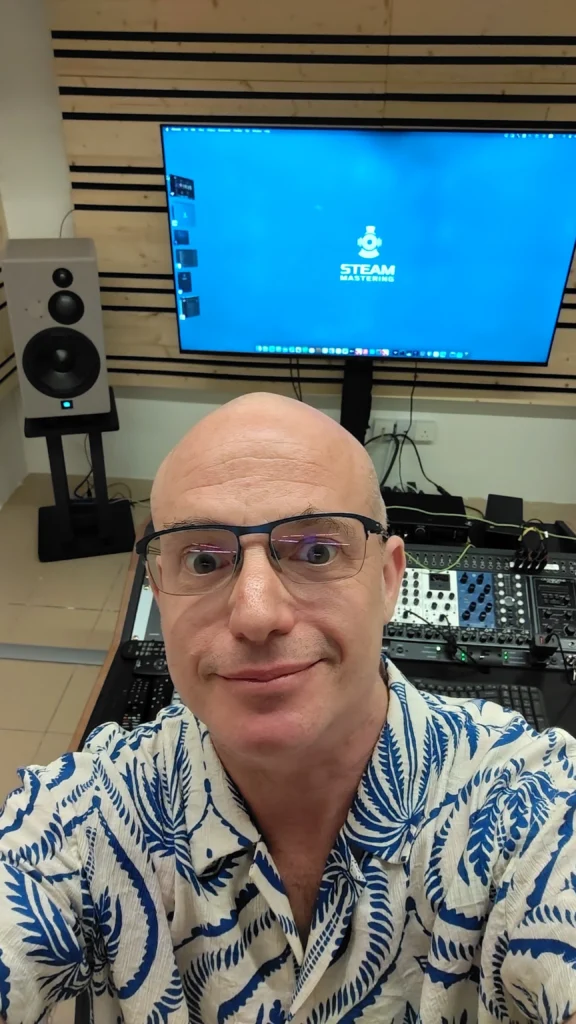
A break from the processors — let’s talk chassis
This week I’m taking a break from the 500-series processor units and talking about the chassis that hold them all together.
I’ve got two Cranborne Audio R8 USB units and a Rupert Neve Designs R10. Each one serves a different purpose, and the more I use them, the more I appreciate how much the chassis choice actually matters.
The Rupert Neve Designs R10
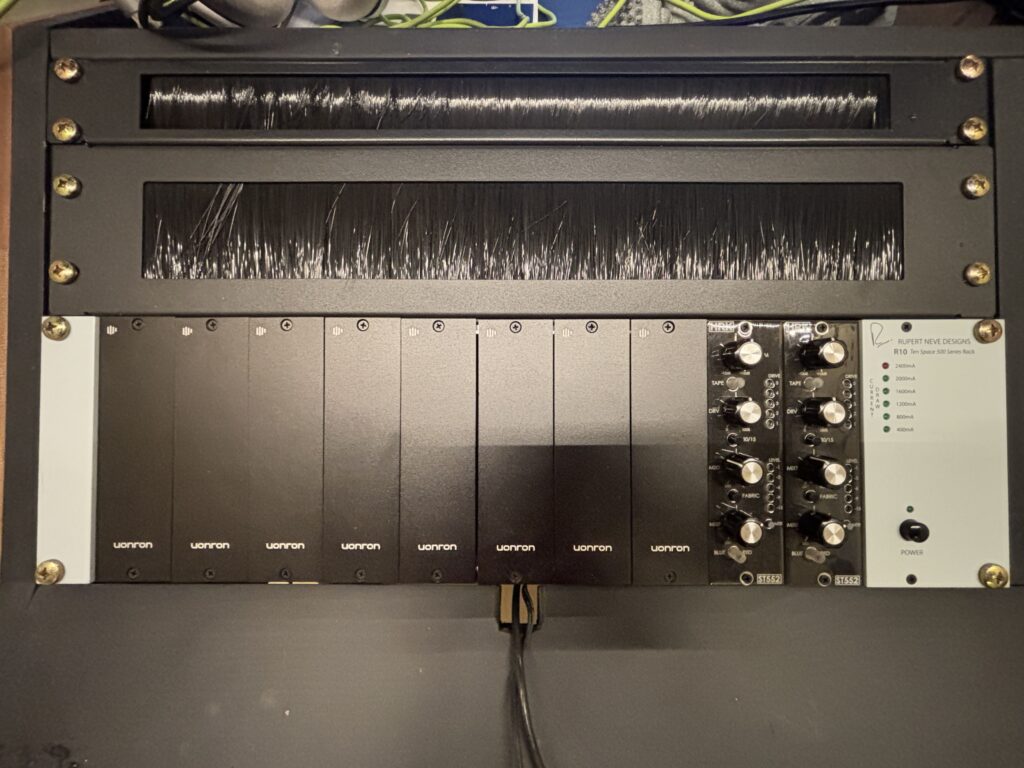
The R10 is a 10-space unit. It looks great and has an ample power supply. Not a great deal else to say about it, honestly — it’s high quality and will probably run for many years without issue. Check the full specs at rupertneve.com.
It’s got XLR and TRS options for ins and outs, and link jumpers to pair channels for VCA linking — useful if you’re running stereo compressor modules like the 543 or 535 that need shared gain reduction. Note that these don’t route audio directly between slots; each module’s I/O is independent unless you patch externally.
The Cranborne Audio 500R8 USB — more than a rack
The 500R8 is more interesting. It’s not just a 500-series rack — it’s a system. And honestly, one of these could be all someone needs. Full specs at cranborneaudio.com.
It’s an audio interface with 28 inputs and 30 outputs. Sixteen channels of ADAT I/O at 44.1 or 48 kHz — or 8 at 88.2 or 96 kHz. There’s also SPDIF, though it’s limited to 44.1 and 48 kHz, which is one of my only complaints about the unit. Mix out, master out, and auxiliary out are all on board too.
There are also CAT6/RJ45 inputs and outputs for routing analogue via Cranborne’s CAST system. I don’t use it myself, so I can’t comment in detail — but pairing it with a Cranborne 500-ADAT does something special. I’ll get to that.
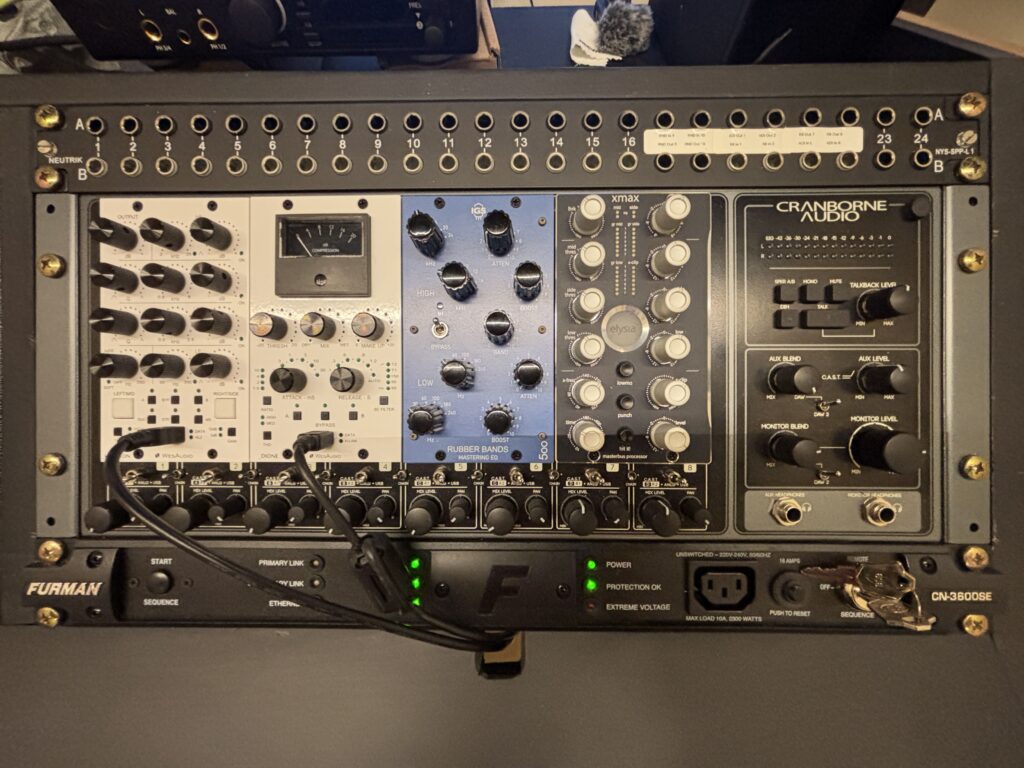
The routing that changes everything

The most exciting part of the interface routing is the 8 ins and outs connected directly to the 500-series section. Each channel has a switch that lets the input come from the analogue input on the back (XLR), the CAST system, or directly from USB.
If you’re mixing and using this as your interface, that means you don’t need to run any cables for your 500-series units. So long as you don’t need to route them into each other — though if you’re running mono channels and single-width processors, you can do that too.
The converters are genuinely good. I’ve used them in mixing, but I’m yet to test them in a mastering context.
Built-in analogue summing
Another feature worth mentioning — the 500R8 has a built-in mixer for the analogue channels. You can use it for analogue summing. Out of the box you get 4 stereo busses or 8 mono channels.
Cranborne understood that’s a limited number, so they provided a built-in solution. That’s the magic I mentioned earlier. If you pair the 500R8 with the 500-ADAT, it can sum 16 channels — or 8 stereo pairs.

How I’ve got them set up
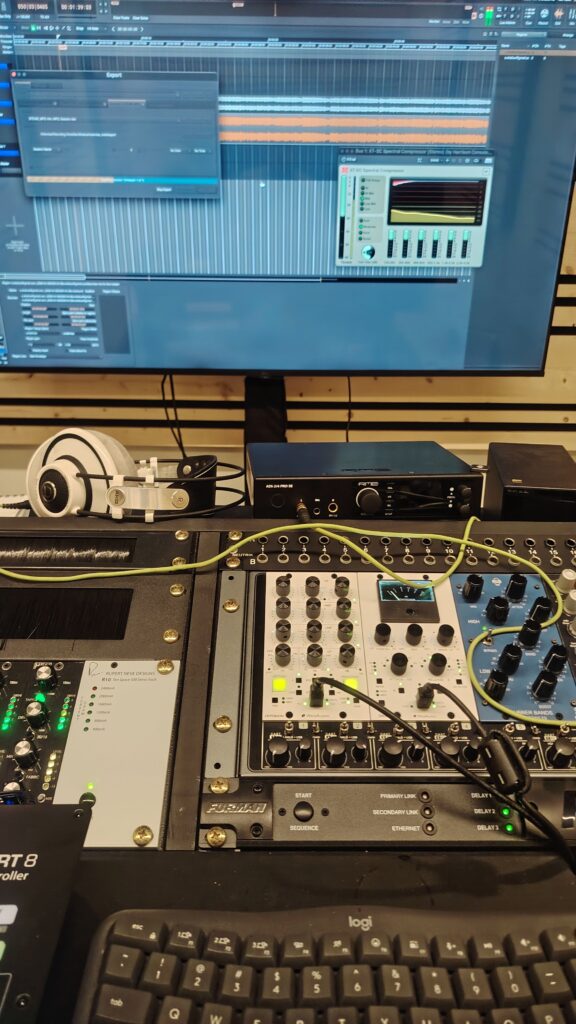
For mastering, I have each stereo unit feeding into the next. Everything in the chain has a true bypass, so if I’m not using a device, it’s not interfering with the signal.
It’s a luxury to be able to run a 500-series unit directly on an insert in your DAW without thinking about cables. That workflow is hard to walk away from once you’ve had it.
The upgrade temptation
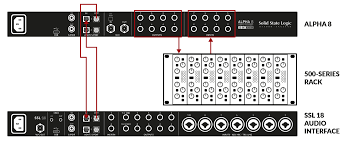
My current upgrade plan is to add something like the SSL Alpha 8 to route in and out of the Rupert Neve. I’ve even got the patch bay plan drawn up. That also means making or buying 32 new cables — and that’s not including any patch cables.
So while this setup is great, and the idea of getting a different converter for the R10 to access a different tonal flavour is appealing — the thought of more channels without more cables, plus proper analogue summing, has me thinking about the next move when time and budget allow.
Limitations to consider

A few things worth flagging. The insert points on each channel and the master buss are unbalanced — that doesn’t work for me. The SPDIF is limited to 44.1 and 48 kHz. And the 500R8 is supposedly class compliant, but it had issues changing sample rate when working with Linux.
Specs worth reading
For a deep dive on the 500R8, Hugh Robjohns did an excellent review for Sound on Sound — one of my favourite reviewers in the game. Worth a read if you’re comparing options.
Final thoughts
Chassis don’t get the same attention as processors, but they shape your workflow more than you’d think. The R10 is a straightforward, high-quality workhorse. The 500R8 is a genuine hybrid system that could be the centre of a whole studio.
If you’ve got questions about either unit, or you’re curious how your music might sound mixed or mastered through this setup — reach out. Always happy to talk shop.